
As a reflective musician I spend a good deal of my time analysing what has gone on and thinking about what to do next. I am currently writing a book about my practice as a social musician and on this page will share some of that writing.
Below are a couple of articles.
Creative Music-making in Care Homes.
By Hugh Nankivell
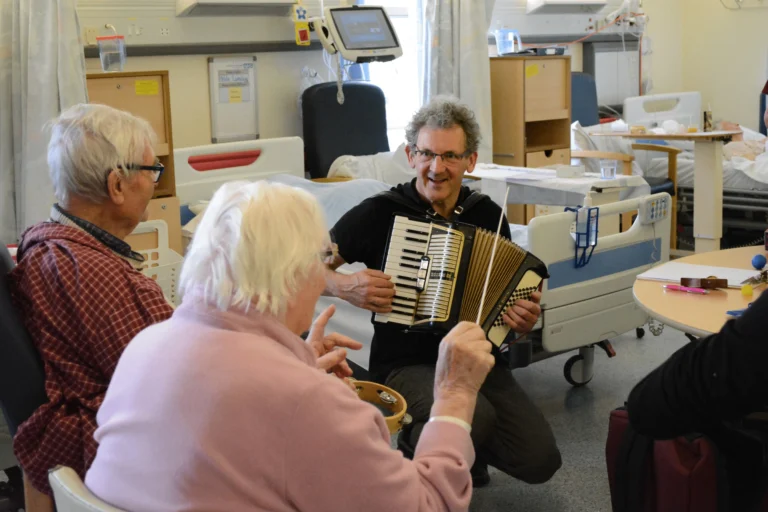
I am Hugh Nankivell – a social musician and composer based in Bristol. In the last decade I have spent a lot of time working and playing with older people in care homes and hospitals, with a focus on those living with dementia. I am committed to exploring the relief and magic that music can bring in these settings.
For the last two years I have been leading training, and offering support, for players from BBC National Orchestra of Wales in developing their practice as musicians in care homes. These musicians are highly skilled instrumentalists who often have a wide repertoire and work in various combinations of players. Historically their practice has primarily been as performers of existing music, playing from sheet music on music stands.
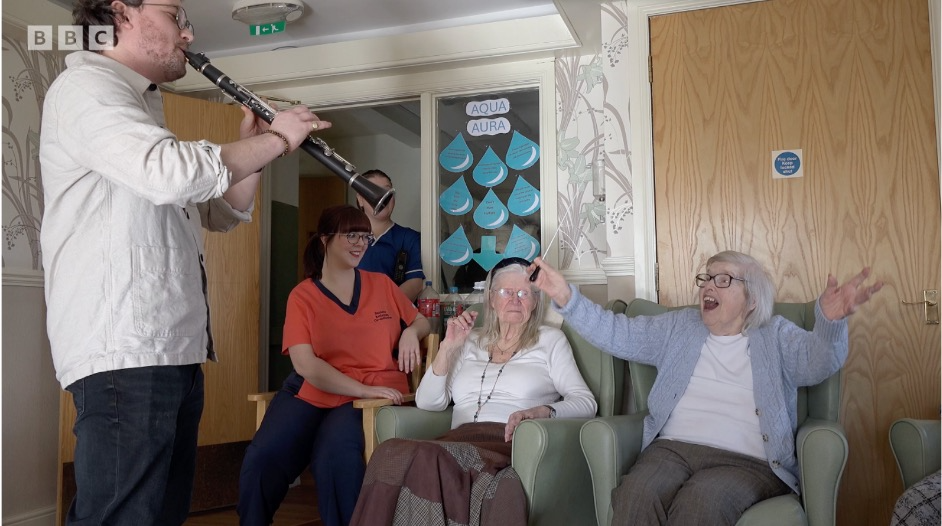
We are developing a framework to look at how musicians can engage more with the residents through developing creative approaches in addition to the playing of existing repertoire. As a result, eight activities have emerged, all of which can be used to encourage direct connections between players and residents. These activities require some players to re-evaluate their existing approach, and for new skills to be developed. We have made a film exploring these through working in a care home in Pontypool called Regency House.
We are not expecting that all eight activities will be used in every session, but are encouraging players to have them as a checklist when preparing for sessions.
They are:
- Greeting
- Playing
- Moving
- Listening
- Composing
- Conducting
- Singing
- Parting
(Only Greeting and Parting need to be 1st and last – the others might come in any order!)
The following are some notes for players regarding these activities.
- Greeting – make sure you say hello to everyone – even if this takes time. Learn their names and give them a chance to answer, even if they are slow at responding.
- Singing – singing is probably the main way in which most of the group will be able to join in with you. Perhaps do some warming up of the voice before singing, and look at the residents as you sing with them. Prepare a selection of songs. Ask them to suggest a song or a tune they like? You don’t have to worry about not knowing it as you could perhaps learn it for next time or ask them to sing it to you.
- Listening – they are going to be listening to you, but make sure you also listen to them. People always appreciate knowing that they are being listened to. Can you do some specific listening games with them – e.g. by asking ‘does anyone know what that tune was?’ – or ‘here is the opening of a well known song/tune – do you know what it is?’ – or even a little musical quiz? In that way there is real listening going on. Ask the group to give themselves a band name. (At Regency House, the band became The Regency Regals.)
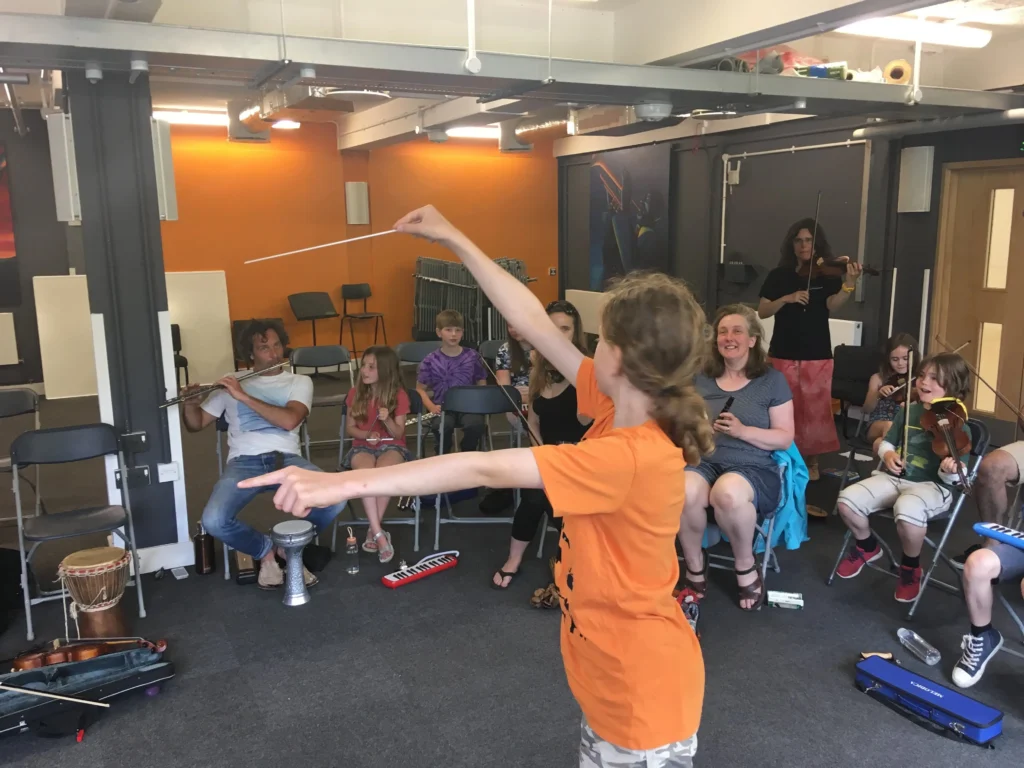
- Conducting – this is a really good way to give some agency to those who may not have much anymore, and especially post-verbal people. As soon as you start to play you may notice some folks starting to conduct. Give them a baton, and then at some point invite them to actually conduct you rather than just to conduct ‘as an accompaniment’. Allow the person with the baton to control the speed and the flow as you improvise and really pay attention to that person.
- Playing – Take instruments along for residents to play. It is important to think about what instruments you are using and when you give them out. Small percussive egg-shakers are often good for starting with before moving onto others (small drums, glockenspiels etc). Playing just generally in time with the music may be better than trying to have particular percussion parts. Have the instruments ready to hand to give out, so that process does not take too long. Also remember that play is the word to describe what we do as musicians.
- Moving – Can you do a specific song/tune with movements? Can you prepare a physical warm-up tune with movements? When you see movement – respond to it and encourage it. Perhaps one of you could dance with a resident!
- Composing Can you compose a new song with the group? Or ask them to call out some notes and you improvise a tune around these notes. In this way you can develop a new repertoire for the group that is entirely unique. (I am aware that as a composer this is a skill I am comfortable with and many players much less so, but these skills of encouraging group composition can be learned.)
- Parting – make sure you have a goodbye tune that you perhaps play each time. Say goodbye to everyone in turn, see if you can remember their names.
I often remind players that music stands can become like walls. When they are removed and music is played by memory or improvised then the connections between players and residents can suddenly open up. I also encourage them to be prepared to change their plan when necessary, and to think of themselves as fellow human being enjoying the experience of playing music with others, rather than someone for whom music is a job.
Thanks very much to all the players at BBCNow and also Bea Carey Education Producer.